Professor David Moore
108 Broad Hall
Office extension: 71648
E-mail: dmoore@pitzer.edu
Pitzer College
Psychology
112
Research Methods
Fall, 2008
Here's the most pertinent info--I'll discuss details in class.
Class
meets Tuesdays & Thursdays from 12:00 p.m. - 1:10 p.m.,
in Broad Hall 214.
My
OFFICE HOURS will be on:
Mondays from 4:00
p.m. - 5:00 p.m., and
Tuesdays from 4:00 p.m. - 5:00 p.m.
If
I need to
change these as the semester's schedule becomes
clearer, I'll obviously let you know. But, do note that because of the
nature of this course, I'll probably be meeting with each of you quite
a lot in my office--that will be the best way for me to handle
questions that arise about your individual projects. So, I'm free to be
scheduled--try to let me know ahead of time if you're hoping to stop in
to talk. Under any circumstances, I'll be in my
office or lab lots, so you can just drop on in.
The REQUIRED TEXTBOOKS are:
 Schweigert,
W.A. (2006). Research methods in psychology: A handbook (2nd ed.).
Waveland Pr Inc.
Schweigert,
W.A. (2006). Research methods in psychology: A handbook (2nd ed.).
Waveland Pr Inc.
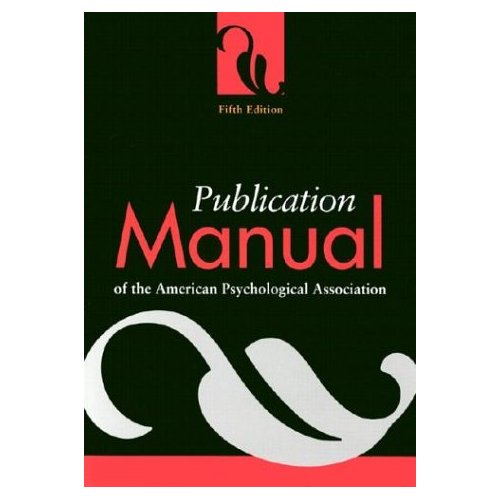 American
Psychological Association (2001). Publication Manual of the American
Psychological Association (5th ed.). Washington, D.C.: Author.
American
Psychological Association (2001). Publication Manual of the American
Psychological Association (5th ed.). Washington, D.C.: Author.
Other recommended BOOKS are:
 Horvat, J.
& Davis, S. (1997). Doing psychological research. Upper Saddle
River, NJ: Prentice Hall.
Horvat, J.
& Davis, S. (1997). Doing psychological research. Upper Saddle
River, NJ: Prentice Hall.
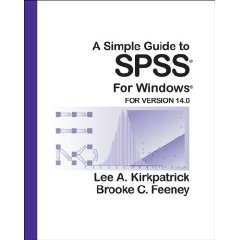 Kirkpatrick, L.A.
& Feeney, B.C. (2006). A simple guide to SPSS for Windows,
Version 14.0 (8th ed.). Belmont, CA: Wadsworth.
Kirkpatrick, L.A.
& Feeney, B.C. (2006). A simple guide to SPSS for Windows,
Version 14.0 (8th ed.). Belmont, CA: Wadsworth.
A
NOTE ABOUT THESE BOOKS: You should definitely buy the APA Publication
Manual. You'll also want a book on SPSS to refer to, although if you
prefer, you can feel free to use something other than Kirkpatrick.
Finally, I think Horvat & Davis could be a useful supplement if
you have it,
but if you're confident that you can get all the information you need
to create your thesis from Schweigert, you could consider this book to
be merely recommended.
**************************************************
As
indicated by its name, the purpose of this course is to learn how to
design research studies in psychology. The course has been designed for
students who were invited last spring to write a senior honors thesis
in psychology this year. To that end, the main goal of the course will
be to have developed an honors-quality research proposal by the end of
the semester, and to have collected and analyzed some preliminary
("pilot") data, so that you'll have a good head start on your honors
thesis, which will be completed in the spring semester.
Among the
topics we will cover in the course are:
- Methods and theory of
scientific research
- How to conduct a thorough
literature review
- How to write a
scientific research report
- How to analyze data
using SPSS for Windows
- Ethical issues in the conduct of research
- Cross-cultural and gender considerations
Note
that at the end of the fall semester, each of you will be required to
present your pilot data (in the context of a broader presentation about
your project) to the members of the psychology field group. Only
those students whose data and presentations are of sufficiently high
quality--and who achieve a B or better in this course--will be allowed
to continue in the honors program. Those students will
enroll in
Psychology 191 (Senior Thesis in Psychology) next spring; this course
will include a once-a-week meeting designed to support students in
their data-gathering and thesis-writing. A
rough draft of the thesis will be due 4 weeks before the end of the
spring semester (April 10) and the final thesis will be due 2 weeks
later (April 24).
To
receive honors in psychology at graduation, a student must have
successfully completed a senior thesis and have met GPA criteria
specified in the Pitzer
College Course Catalogue.
At the end of the spring semester, students may be asked to present
their completed theses to the entire psychology department.
Click
here to return to Psych 112 HOMEPAGE
Click
here to see Psych 112 SYLLABUS
Click
here to see Psych 112 GOALS
Click
here to see Psych 112 REQUIREMENTS
Click
here to go to David Moore's homepage